

In 2025, platforms using Safer processed 415.4 billion files. More than 3.8 million of these files were suspected novel CSAM. Every flagged file puts your platform and users at risk.
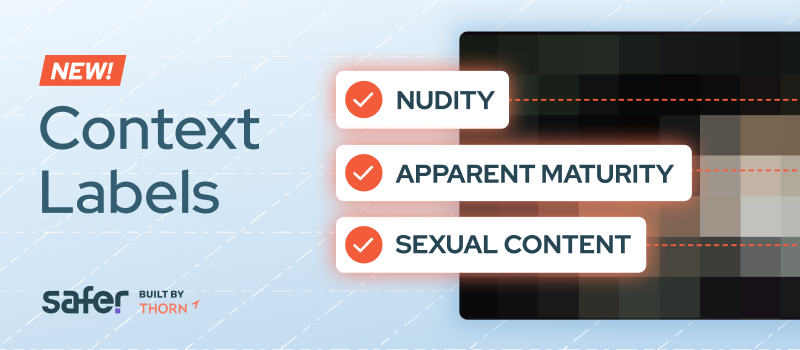
But detection is only the first step. Today, we’re introducing a new layer of insight to Safer. Three predictive Context Labels that bring greater clarity to CSAM moderation workflows.
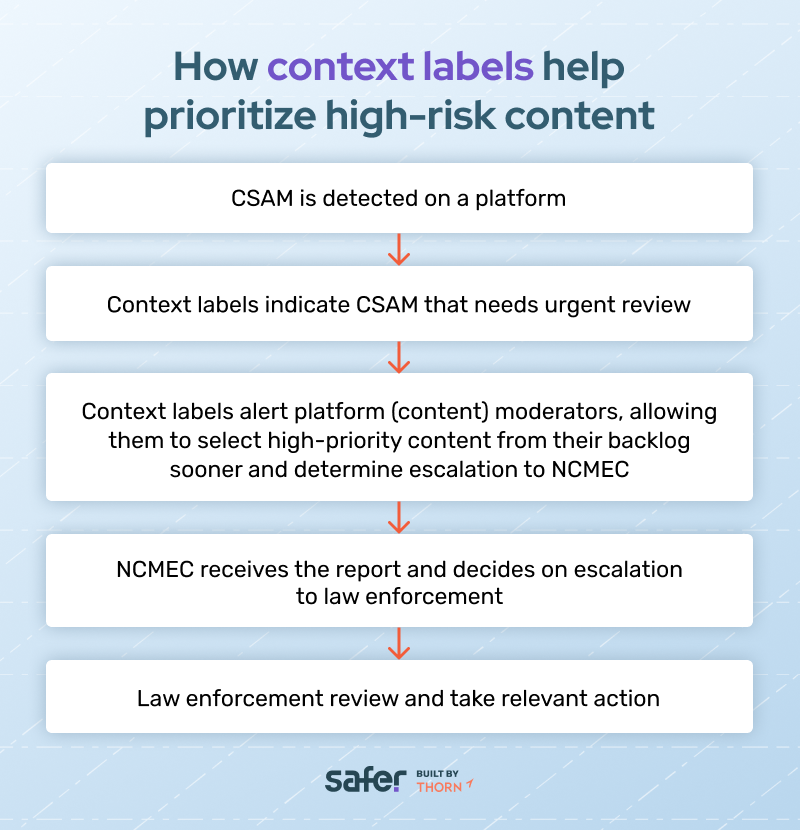
Each novel file of suspected CSAM needs to be verified by a person. With today’s volume of material, even large trust and safety teams can build a backlog that needs review. How can they go through so much flagged content quickly and effectively? Which files are most important to review because they have the most urgent cases? When capacity is limited, teams often have to make decisions without sufficient information.
How do Safer’s Context Labels support trust and safety teams?
Safer’s Context Labels add extra information to make detection signals easier to act on. These predictive Context Labels help platforms go beyond baseline detection by adding contextual signals that support prioritization and reporting workflows.
1. More effective prioritization of harm
Not all flagged content is equally risky. Without guidance, it’s hard to know which files need immediate attention. Context Labels help teams quickly find and escalate high-risk material by providing clearer indicators of content type and severity. By showing levels of harm that match ecosystem definitions, the labels help moderators focus on the most severe cases first.
2. Stronger reporting and ecosystem impact
Context Labels help produce more detailed, organized reports, giving NGOs and law enforcement a clearer view of escalated cases. This extra information helps partners focus their efforts where they can have the biggest impact. For example, investigators can sort and prioritize high-risk cases.
In fact, Safer’s Context Labels were developed with input from the INTERPOL DevOps community and use a shared industry language. Each label follows definitions from the Universal Classification Schema (UCS V2), developed by INHOPE and partners.** This collaborative listing, developed by multiple organizations and agencies in online safety, addresses inconsistent definitions of CSAM across jurisdictions, enabling seamless data exchange and more coordinated responses. Adhering to it with Safer’s Context Labels brings more consistency to the safety ecosystem.
3. Better wellness for moderators
Context Labels help teams create wellness-forward review processes by giving clear information about the type and severity of content before it’s viewed. This extra context can support better handling and help organizations make more informed decisions about reviewer support and well-being.
4. Improved visibility and trend detection
Context Labels help teams notice new patterns. When moderation policies or platform features change, more robust detection information helps track the impact of those decisions. By using standard categories like nudity, apparent maturity level, and sexual content, it’s easier to spot trends over time. These new labels can help guide safety plans and resource management.
What are Safer’s Context Labels?
Safer’s Context Labels add another layer of predictive signals to suspected CSAM files. They are made to help platforms prioritize, review, and handle suspected CSAM more effectively. The labels are based on three specialized classifiers that assess:
- Nudity
- Apparent maturity level
- Sexual content
Together, these labels give trust and safety teams more information to help them prioritize content for moderation. Like other Safer models, these classifiers are trained on confirmed CSAM to make sure they are relevant and reliable in real situations. The goal is to give safety professionals a clearer understanding of suspected CSAM content to help find and raise higher-risk material for review.
How can trust and safety teams deploy Safer’s Context Labels?
Safer’s Context Labels meet trust and safety teams where they are. They can integrate seamlessly into existing workflows, whether teams rely on Safer’s review tool or their own in-house review systems. Context Labels can be run on any material identified as suspected CSAM by hashing or classification, adding information to an important step in the moderation process. This flexibility makes it easier to add more context without disrupting moderation processes.
As the challenges facing platforms continue to evolve, so too must the tools designed to address them. Adding context to detection is a critical step toward more effective, more scalable moderation. Ultimately, this leads to better protection for children online. This work builds on years of Thorn’s investment in child safety. Context Labels are the product of deep domain expertise, ongoing collaboration with partners across the ecosystem, and a shared commitment to improving how the industry responds to suspected online child sexual abuse material.
To learn more about Context Labels in Safer or to see how they can support your team, get in touch or check out our on demand demo.
** The apparent maturity level, nudity, and sexual content classifiers were developed with the support of the INTERPOL DevOps community. Each classifier produces labels which have a series of descriptions, defined in accordance with the Universal Classification Schema V2, developed by InHope and partners, with the goal of using a shared language throughout the ecosystem.
Thorn’s use of the Universal Classification Schema is provisioned through a license with InHope. InHope exclusively holds all intellectual property rights in and to the Schema, and any use of the Schema outside of Safer is subject to InHope’s consent.